DANL 200: Introduction to Data Analytics
DANL 200 - Homework Assignment 2 - Example
Answers
Byeong-Hak Choe
2023-02-14
Loading R packages for Homework Assignment 2
library(tidyverse)Question 1
Read the data file, NY_school_enrollment_socioecon.csv,
as the data.frame object with the name,
NY_school_enrollment_socioecon, using (1) the
read_csv() function and (2) its URL,
https://bcdanl.github.io/data/NY_school_enrollment_socioecon.csv.
url <- 'https://bcdanl.github.io/data/NY_school_enrollment_socioecon.csv'
NY_school_enrollment_socioecon <- read_csv(url)
For description of variables in
NY_school_enrollment_socioecon, refer to the file,
ny_school_enrollment_socioecon_description.zip, which is in
the Files section in our Canvas web-page. (I recommend you to extract
the zip file, and then read the file,
ny_school_enrollment_socioecon_description.csv, using Excel or
Numbers.)
Q1a
Look up the meaning of variables d01_018,
d01_021, d01_024, and d01_027,
from the file,
ny_school_enrollment_socioecon_description.csv.
Find the top 5 counties in terms of the value of variable
d01_018for each year.Find the top 5 counties in terms of the value of variable
d01_021for each year.Find the top 5 counties in terms of the value of variable
d01_024for each year.Find the top 5 counties in terms of the value of variable
d01_027for each year.Make a comment on the result.
Q1a_25_34 <- NY_school_enrollment_socioecon %>%
  select(year, county_name, d01_018) %>%
  group_by(year) %>%
  filter(min_rank(desc(d01_018)) <= 5) %>%
  arrange(year, -d01_018)

Q1a_35_44 <- NY_school_enrollment_socioecon %>%
  select(year, county_name, d01_021) %>%
  group_by(year) %>%
  filter(min_rank(desc(d01_021)) <= 5) %>%
  arrange(year, -d01_021)

Q1a_45_64 <- NY_school_enrollment_socioecon %>%
  select(year, county_name, d01_024) %>%
  group_by(year) %>%
  filter(min_rank(desc(d01_024)) <= 5) %>%
  arrange(year, -d01_024)

Q1a_65_over <- NY_school_enrollment_socioecon %>%
  select(year, county_name, d01_027) %>%
  group_by(year) %>%
  filter(min_rank(desc(d01_027)) <= 5) %>%
  arrange(year, -d01_027)

# rank() and dense_rank() would also be okay.

# Here I do not provide any comments on the result.
Q1b
Look up the meaning of variables c02_010,
c04_010, and c06_010 from the file,
ny_school_enrollment_socioecon_description.csv.
Find the top 5 counties in terms of the value of variable
c02_010for each year.Find the top 5 counties in terms of the value of variable
c04_010for each year.Find the top 5 counties in terms of the value of variable
c06_010for each year.Make a comment on the result.
Q1b_college <- NY_school_enrollment_socioecon %>%
  select(year, county_name, c02_010) %>%
  group_by(year) %>%
  filter(min_rank(desc(c02_010)) <= 5) %>%
  arrange(year, -c02_010)

Q1b_college_pub <- NY_school_enrollment_socioecon %>%
  select(year, county_name, c04_010) %>%
  group_by(year) %>%
  filter(min_rank(desc(c04_010)) <= 5) %>%
  arrange(year, -c04_010)

Q1b_college_prv <- NY_school_enrollment_socioecon %>%
  select(year, county_name, c06_010) %>%
  group_by(year) %>%
  filter(min_rank(desc(c06_010)) <= 5) %>%
  arrange(year, -c06_010)

# Here I do not provide any comments on the result.
Q1c
Look up the meaning of variable pincp from the file,
ny_school_enrollment_socioecon_description.csv.
Provide both (1) one ggplot code with geom_line() and
(2) a couple of sentences to describe the yearly trend of
pincp for Livingston county and top 4 counties in terms of
the mean value of pincp over the years,
2015-2020.
NY_school_enrollment_socioecon %>%
  select(year, county_name, pincp) %>%
  group_by(county_name) %>%
  mutate( pincp_mean = mean(pincp) ) %>%
  ungroup() %>%
  filter( dense_rank(desc(pincp_mean)) <= 4 |
            county_name == "Livingston" ) %>%
  ggplot() +
  geom_line(aes(x = year, y = pincp, color = county_name)) +
  geom_point(aes(x = year, y = pincp, group = county_name))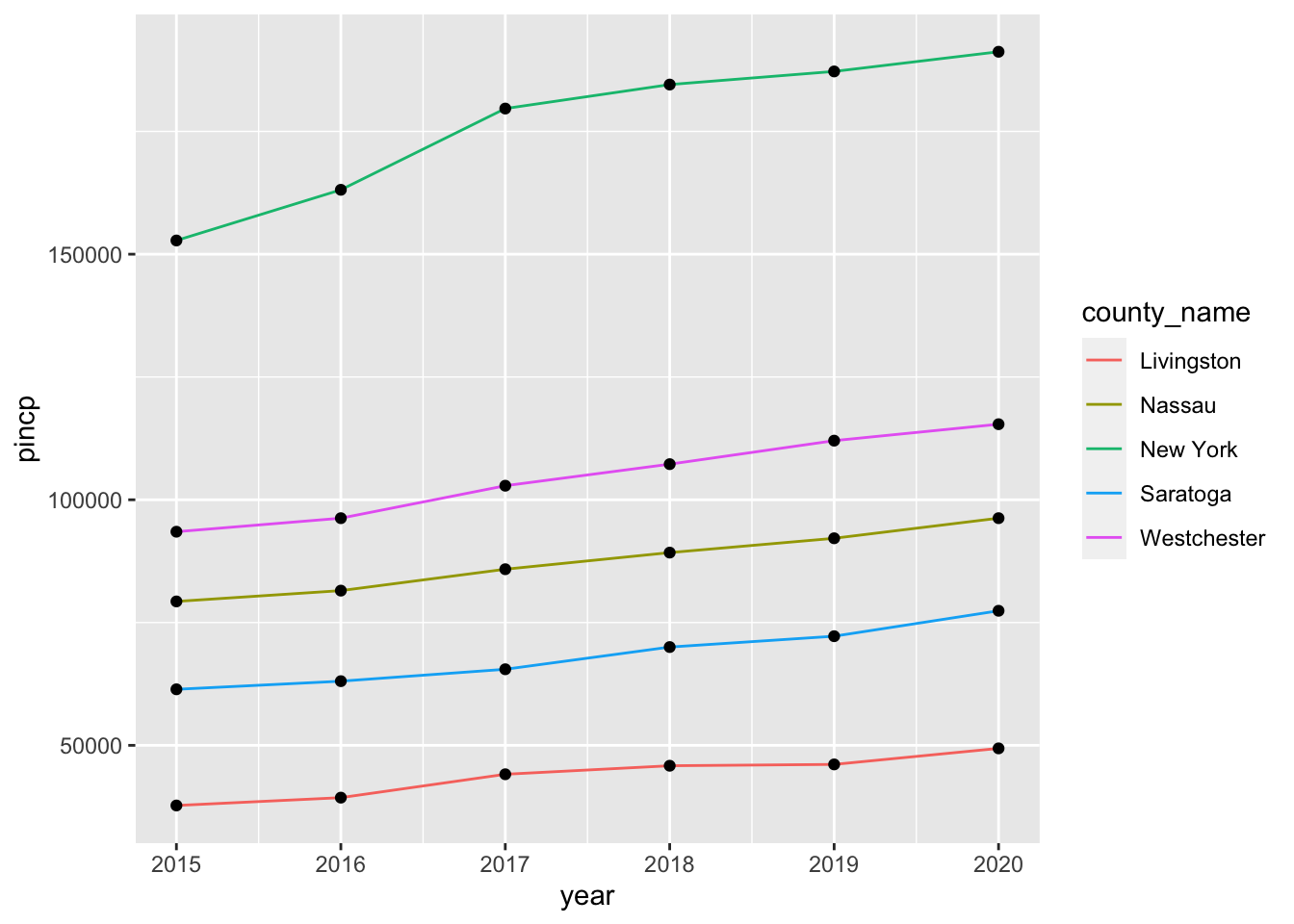
# Here I do not provide any comments on the result.Q1d
Create the variable of the growth rate of pincp, where
the growth rate of pincp is defined as:
\[ (\text{Growth rate of } \texttt{pincp}
\text{ in year } \texttt{Y})
= \frac{( \texttt{pincp} \text{ in year } \texttt{Y} ) - (
\texttt{pincp} \text{ in year } \texttt{Y-1} )}{(\texttt{pincp} \text{
in year } \texttt{Y-1} )} \] Provide both (1) one ggplot code
with geom_line() and (2) a couple of sentences to describe
the yearly trend of the growth rate of pincp for Livingston
county and top 5 counties in terms of the mean value of the growth rate
of pincp over the years,
2016-2020.
NY_school_enrollment_socioecon %>%
  select(year, county_name, pincp) %>%
  group_by(county_name) %>%
  mutate(g = 100 * (pincp - lag(pincp)) / lag(pincp),
         g_mean = mean(g, na.rm = T) ) %>%
  ungroup() %>%
  filter( (dense_rank(desc(g_mean)) <= 4 |
            county_name == "Livingston") & !is.na(g) ) %>%
  ggplot() +
  geom_line(aes(x = year, y = g, color = county_name)) +
  geom_point(aes(x = year, y = g, group = county_name))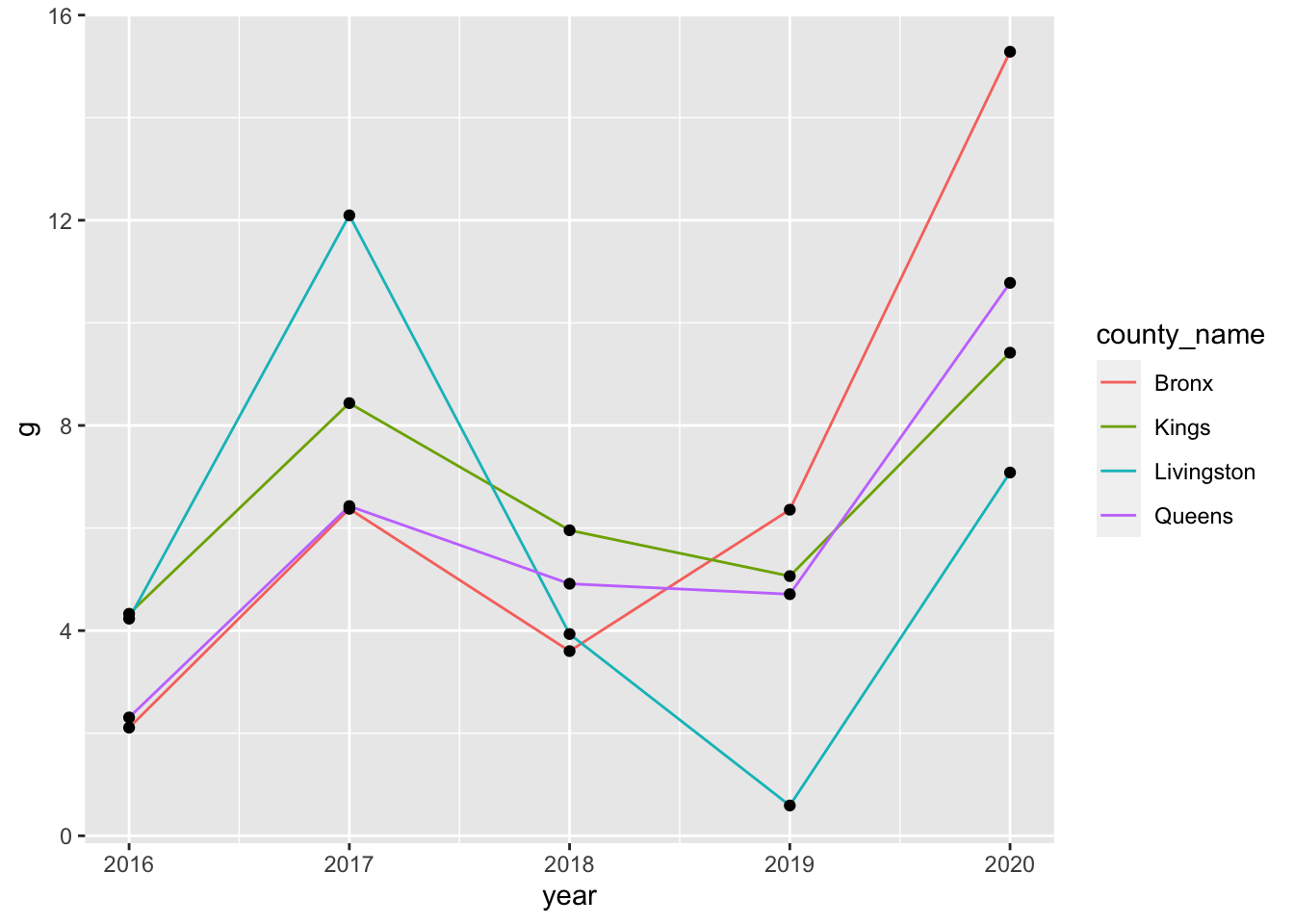
# Here I do not provide any comments on the result.Q1e
Look up the meaning of variable poverty_hs and
poverty_bachelor_or_higher from the file,
ny_school_enrollment_socioecon_description.csv.
Summarize the mean value of
poverty_hsandpoverty_bachelor_or_higherfrom years2015to2020for each county.Provide both (1) a ggplot code with
geom_point()and (2) a couple of sentences to describe the mean value ofpoverty_hs.Provide both (1) a ggplot code with
geom_point()and (2) a couple of sentences to describe the mean value ofpoverty_bachelor_or_higher.
q1e <- NY_school_enrollment_socioecon %>%
  group_by(county_name) %>%
  summarise(poverty_hs = mean(poverty_hs),
            poverty_bachelor_or_higher = mean(poverty_bachelor_or_higher))

ggplot(q1e) +
  geom_point(aes(x = poverty_hs,
                 y = county_name))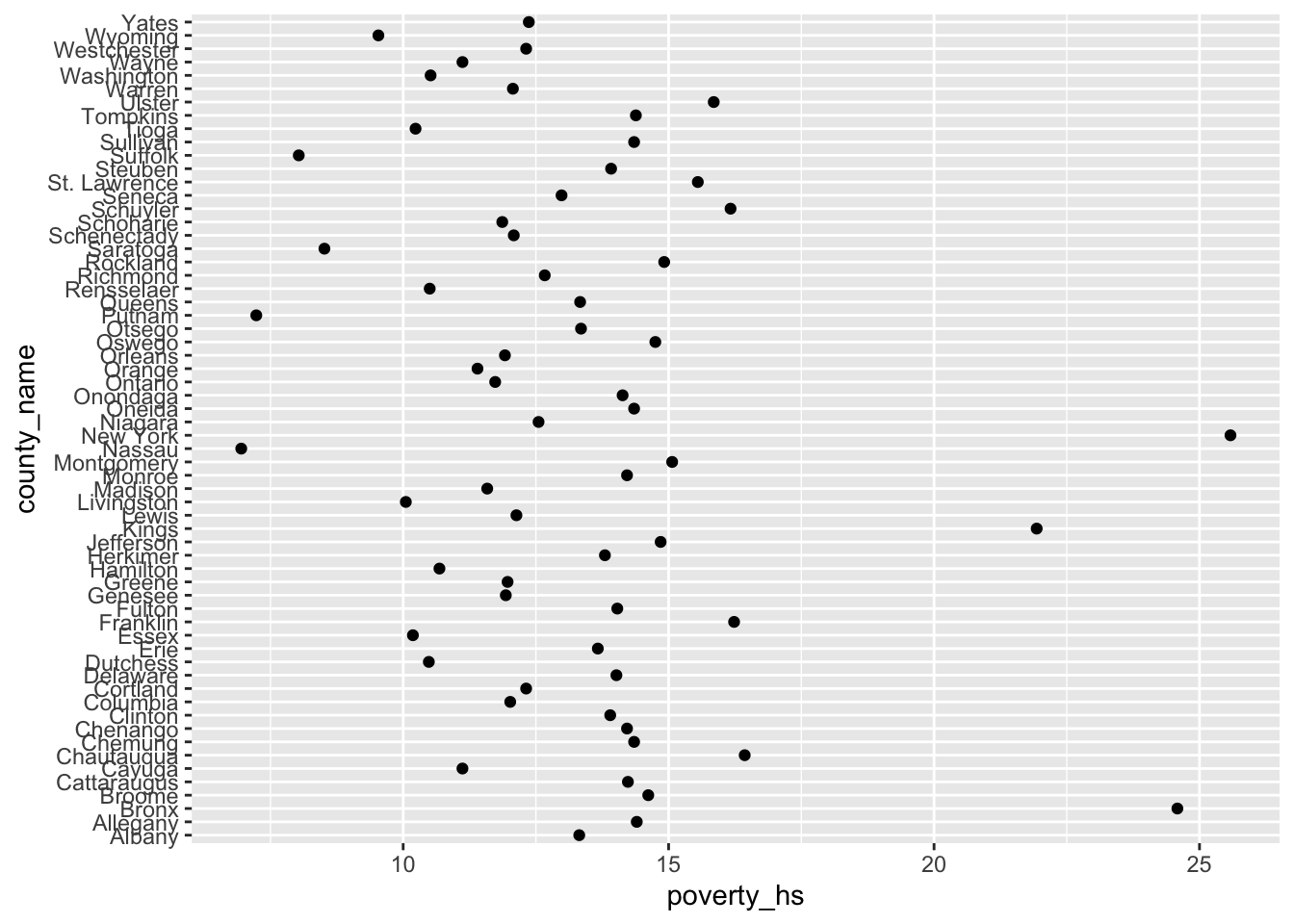
ggplot(q1e) +
  geom_point(aes(x = poverty_hs,
                 y = reorder(county_name, poverty_hs)))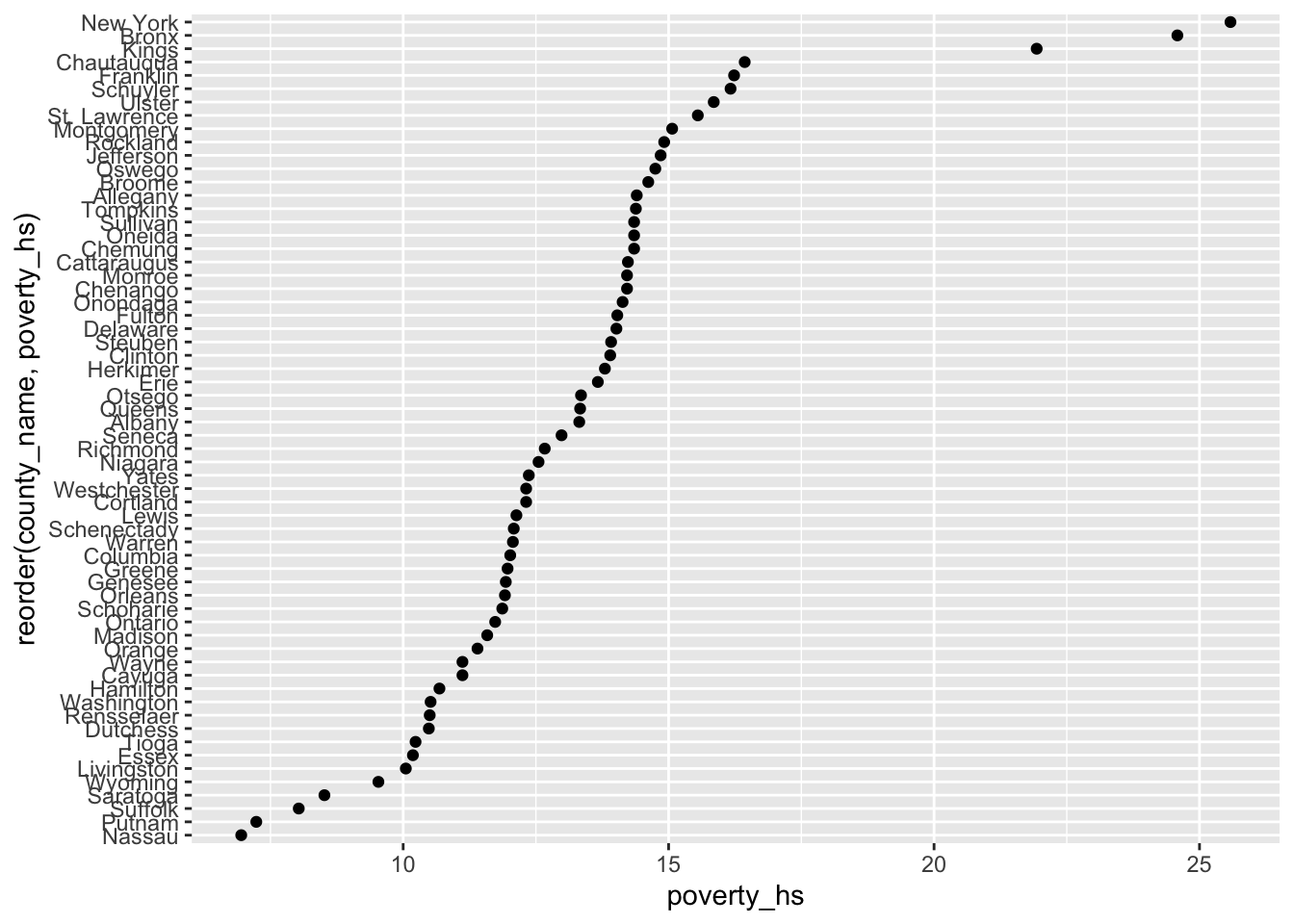
ggplot(q1e) +
  geom_point(aes(x = poverty_bachelor_or_higher,
                 y = county_name))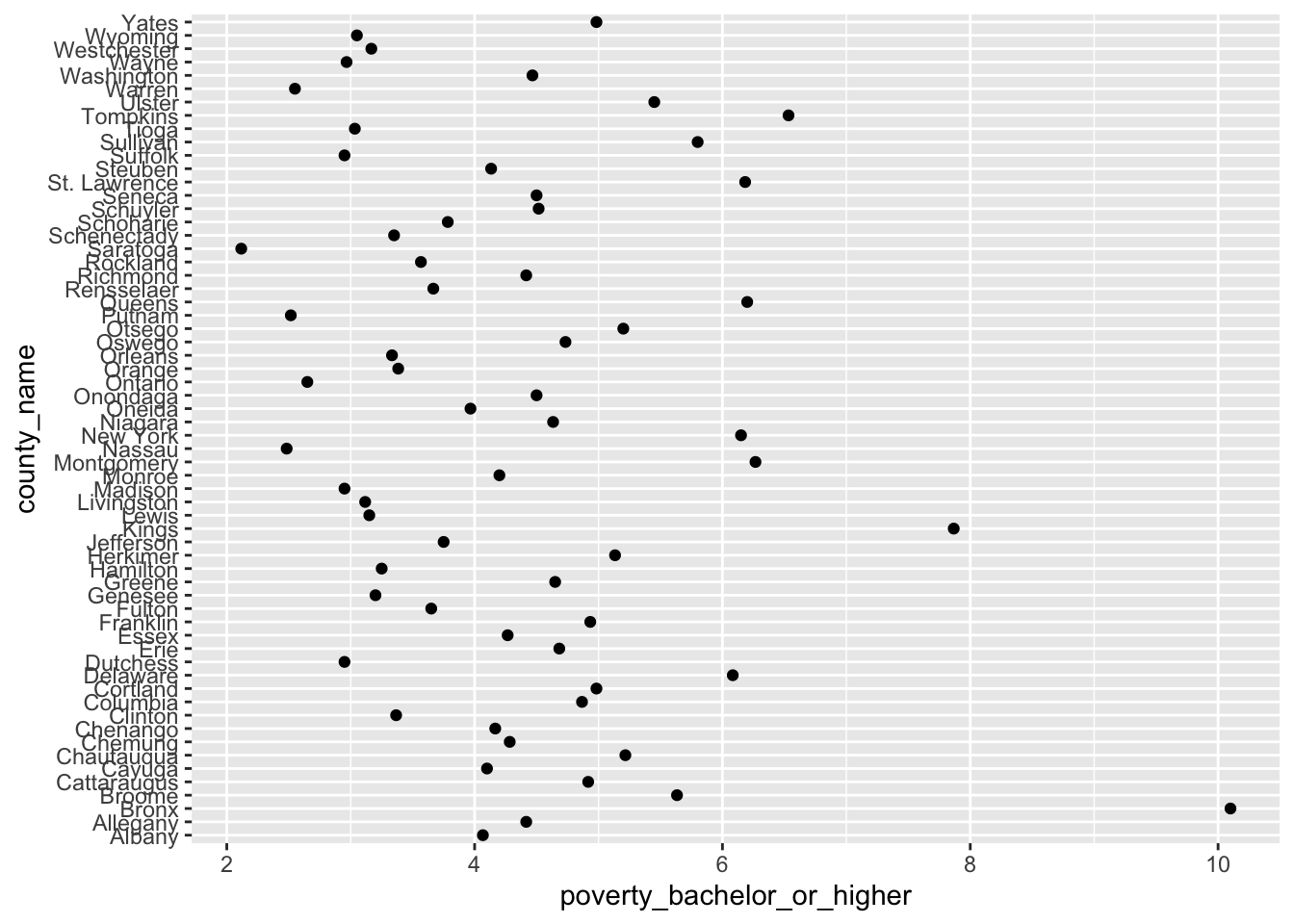
ggplot(q1e) +
  geom_point(aes(x = poverty_bachelor_or_higher,
                 y = reorder(county_name, poverty_bachelor_or_higher)))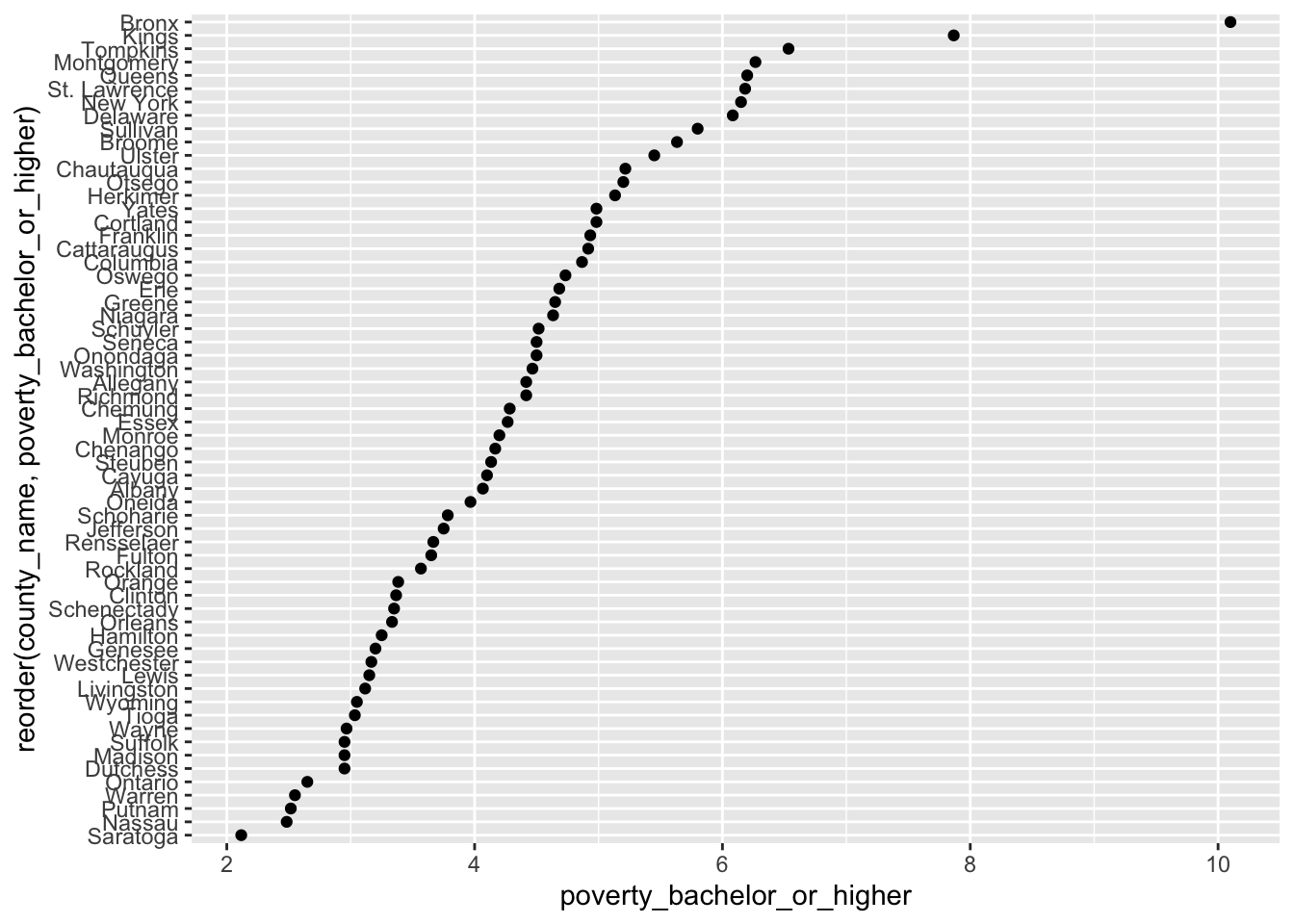
# Here I do not provide any comments on the result.Question 2
Read the data file, beer_markets.csv, as the data.frame
object with the name, beer_markets, using (1) the
read_csv() function and (2) its URL,
https://bcdanl.github.io/data/beer_markets.csv.
beer_markets <- read_csv(
  'https://bcdanl.github.io/data/beer_markets.csv'
)
Description of variables in the data file,
beer_markets.csv
Each observation in beer_markets.csv is a
household-level record for one transaction of beer.
hh: an identifier of the household;X_purchase_desc: details on the purchased item;quantity: the number of items purchased;brand: Bud Light, Busch Light, Coors Light, Miller Lite, or Natural Light;spent: total dollar value of purchase;beer_floz: total volume of beer, in fluid ounces;price_per_floz: price per fl.oz. (i.e., beer spent/beer floz);container: the type of container;promo: Whether the item was promoted (coupon or otherwise);market: Scan-track market (or state if rural);- demographic data, including gender, marital status, household income, class of work, race, education, age, the size of household, and whether or not the household has a microwave or a dishwasher.
Q2a
- Find the top 5 markets in terms of the total volume of beer.
- Find the top 5 markets in terms of the total volume of BUD LIGHT.
- Find the top 5 markets in terms of the total volume of BUSCH LIGHT.
- Find the top 5 markets in terms of the total volume of COORS LIGHT.
- Find the top 5 markets in terms of the total volume of MILLER LITE.
- Find the top 5 markets in terms of the total volume of NATURAL LIGHT.
Q2a1 <- beer_markets %>%
   group_by(market) %>%
   summarize(beer_floz_tot = sum(beer_floz, na.rm = T)) %>%
   arrange(-beer_floz_tot) %>%
   slice(1:5)

Q2a_bud <- beer_markets %>%
  filter(brand == "BUD LIGHT") %>%
  group_by(market) %>%
  summarize(beer_floz_tot = sum(beer_floz, na.rm = T)) %>%
  arrange(-beer_floz_tot) %>%
  slice(1:5)

Q2a_busch <- beer_markets %>%
  filter(brand == "BUSCH LIGHT") %>%
  group_by(market) %>%
  summarize(beer_floz_tot = sum(beer_floz, na.rm = T)) %>%
  arrange(-beer_floz_tot) %>%
  slice(1:5)

Q2a_coors <- beer_markets %>%
  filter(brand == "COORS LIGHT") %>%
  group_by(market) %>%
  summarize(beer_floz_tot = sum(beer_floz, na.rm = T)) %>%
  arrange(-beer_floz_tot) %>%
  slice(1:5)

Q2a_miller <- beer_markets %>%
  filter(brand == "MILLER LITE") %>%
  group_by(market) %>%
  summarize(beer_floz_tot = sum(beer_floz, na.rm = T)) %>%
  arrange(-beer_floz_tot) %>%
  slice(1:5)

Q2a_natural <- beer_markets %>%
  filter(brand == "NATURAL LIGHT") %>%
  group_by(market) %>%
  summarize(beer_floz_tot = sum(beer_floz, na.rm = T)) %>%
  arrange(-beer_floz_tot) %>%
  slice(1:5)
Q2b
For households that purchased BUD LIGHT, what fraction of households did purchase only BUD LIGHT?
For households that purchased BUSCH LIGHT, what fraction of households did purchase only BUSCH LIGHT?
For households that purchased COORS LIGHT, what fraction of households did purchase only COORS LIGHT?
For households that purchased MILLER LITE, what fraction of households did purchase only MILLER LITE?
For households that purchased NATURAL LIGHT, what fraction of households did purchase only NATURAL LIGHT?
Which beer brand does have the largest base of loyal consumers?
beer_markets <- beer_markets %>%
  mutate(bud = ifelse(brand=="BUD LIGHT", 1, 0),
         busch = ifelse(brand=="BUSCH LIGHT", 1, 0),
         coors = ifelse(brand=="COORS LIGHT", 1, 0),
         miller = ifelse(brand=="MILLER LITE", 1, 0),
         natural = ifelse(brand=="NATURAL LIGHT", 1, 0) )

Q2b_bud <- beer_markets %>%
  select(hh, bud) %>%
  arrange(hh, -bud) %>%
  group_by(hh) %>%
  filter(sum(bud) > 0) %>%
  mutate(frac_bud = sum(bud)/n(),
         loyal_bud = ifelse(frac_bud == 1, 1, 0)) %>%
  select(hh, frac_bud, loyal_bud) %>%
  unique() %>%
  ungroup() %>%
  mutate(n_hh_bud = n()) %>%
  group_by(loyal_bud, n_hh_bud) %>%
  summarise(n_obs = n()) %>%
  ungroup() %>%
  mutate(n_frac = n_obs/n_hh_bud )  # 0.6600816


Q2b_busch <- beer_markets %>%
  select(hh, busch) %>%
  arrange(hh, -busch) %>%
  group_by(hh) %>%
  filter(sum(busch) > 0) %>%
  mutate(frac_busch = sum(busch)/n(),
         loyal_busch = ifelse(frac_busch == 1, 1, 0)) %>%
  select(hh, frac_busch, loyal_busch) %>%
  unique() %>%
  ungroup() %>%
  mutate(n_hh_busch = n()) %>%
  group_by(loyal_busch, n_hh_busch) %>%
  summarise(n_obs = n()) %>%
  ungroup() %>%
  mutate(n_frac = n_obs/n_hh_busch )  # 0.472973


Q2b_coors <- beer_markets %>%
  select(hh, coors) %>%
  arrange(hh, -coors) %>%
  group_by(hh) %>%
  filter(sum(coors) > 0) %>%
  mutate(frac_coors = sum(coors)/n(),
         loyal_coors = ifelse(frac_coors == 1, 1, 0)) %>%
  select(hh, frac_coors, loyal_coors) %>%
  unique() %>%
  ungroup() %>%
  mutate(n_hh_coors = n()) %>%
  group_by(loyal_coors, n_hh_coors) %>%
  summarise(n_obs = n()) %>%
  ungroup() %>%
  mutate(n_frac = n_obs/n_hh_coors )  # 0.6390805


Q2b_miller <- beer_markets %>%
  select(hh, miller) %>%
  arrange(hh, -miller) %>%
  group_by(hh) %>%
  filter(sum(miller) > 0) %>%
  mutate(frac_miller = sum(miller)/n(),
         loyal_miller = ifelse(frac_miller == 1, 1, 0)) %>%
  select(hh, frac_miller, loyal_miller) %>%
  unique() %>%
  ungroup() %>%
  mutate(n_hh_miller = n()) %>%
  group_by(loyal_miller, n_hh_miller) %>%
  summarise(n_obs = n()) %>%
  ungroup() %>%
  mutate(n_frac = n_obs/n_hh_miller )  # 0.6312989

Q2b_natural <- beer_markets %>%
  select(hh, natural) %>%
  arrange(hh, -natural) %>%
  group_by(hh) %>%
  filter(sum(natural) > 0) %>%
  mutate(frac_natural = sum(natural)/n(),
         loyal_natural = ifelse(frac_natural == 1, 1, 0)) %>%
  select(hh, frac_natural, loyal_natural) %>%
  unique() %>%
  ungroup() %>%
  mutate(n_hh_natural = n()) %>%
  group_by(loyal_natural, n_hh_natural) %>%
  summarise(n_obs = n()) %>%
  ungroup() %>%
  mutate(n_frac = n_obs/n_hh_natural )  # 0.5096234

# Here I do not provide any comments on the result.
Q2c
- Calculate the number of beer transactions for each household.
- Calculate the fraction of each beer brand for each household.
Q2c <- beer_markets %>%
  count(hh, brand) %>%
  group_by(hh) %>%
  mutate(n_tot = sum(n)) %>%
  arrange(hh, brand) %>%
  mutate( prop = n / n_tot )